Showing posts with label San Diego Djembe Workshop with Mamady Keita and Famoudou Konate June-July 2011. Show all posts

Sunday, 18 August 2013

Day 5 - with Mamady Keita and Saturday: Party Time!

Over the past few days, thanks to Mamady and Famoudou, we have all learned some 'Malinke'. Here are the words we know till date:

Ile - You here

N'de - Me

Isoma - Good morning (to one person - singular)

Aisoma - Good morning (plural)

Ineura - Good evening

Inike - Thank you

Ainike - Thank you all (plural)

Iwuli - You stand up

Wuli - Stand up

Yan - Here

Na Yan - Come here

Tanate - How are you?

Tanacite - I'm fine/good/well.

'Nininka Lilate Filica' - 'He who asks questions will not make mistakes.'

And so we made sure that we posed intermittent questions throughout Friday's session.

Before class started all the djembefola's and djembefollette's were practising their tones and slaps on their respective djembes. The gentlemen sitting to my left looked over at James Kwan (from TTM Hong Kong) who was very calmly playing his djembe in the otherwise, noisy room and asked him, "How do you play so softly and still get your tones and slaps to sound so clear?" James smiled and said in one word, "You relax." It is not a necessity to whack the djembe hard all the time to play a tone or a slap. There is a difference in the physical playing technique for sure but beyond that it is a question of really internalizing the sound of 'Ping', 'Pang' and 'Boom' as one plays the  djembe. Each djembe player will eventually find his or her own special way of playing it. It might differ from another players technique minutely or greatly. The most important thing is to be very clear in the mind as to which sound to get at what particular time, sit comfortably while playing (with the back straight and shoulders relaxed) and to smile and breathe while playing. That makes all the difference.

We started off by completing the previous sessions rhythm 'Bara'. We played the second accompaniment and here's what that sounded like with the Dunun section:

Bara with Dununs

The next rhythm we played is called 'Sumalo.' This rhythm is one of Mamady's creations and is based on a mythical story from West-Africa. The rhythm is named after a king by the name of 'Sumalo' and the story is one of a patriotic mother. Sumalo's kingdom was a famous and  prosperous one. And like the fate of most famous and prosperous kingdoms will have it, they were confronted by a strong enemy. This story talks about a warrior, his wife and son. During the war this gallant warrior was killed. The soldiers returned to the dead warriors home with his battle armour and his sword. These articles were presented to his wife who showed it  to her son. The boy was young and not ready for battle but he wanted to avenge the death of his father and his mother saw reason in this. She took him to the war camp of Sumalo. The boy was identified as too young to fight but his heart was big. He was taken into battle and after some struggles, he too suffered the same fate as his father and died in battle. Once again the son's material remains were brought back to the mother. The mother reacted in a way that she wanted to go to battle and avenge her husband's and son's death and win the war. She went and presented herself to Kind Sumalo and fell at his feet as he approached her. The king picked her up. The mother said, "I will fight." The kind replied calmly, "I know your energy, your spirit and your philosophy. I admire it. Your thoughts are patriotic. but  you do not have the strength to go and fight. Go home and pray for us so that we can go and win this battle for our Kingdom." The mother cried all the way back to her home but she prayed for her King, the brave soldiers and for their safe return. Sumalo's kingdom emerged victorious. The king himself went to report this news to the mother and to thank her for her prayers because of which they won the war.

This rhythm  was created in 1964 and is a tribute to the bravery in women. Women would not take part in battle but had a lot of wisdom and courage and advised kings on strategy of battle.

The words of the songs are:

Sumalo Sumalo (Name of King)

Sofalu Barawuli (The warriors are ready)

Ila Kola Yan (For you here)

This is how we were taught the words of the song: Sumalo Song

This took me back to my memories of a quaint little village school close to Amby Valley called Shaktiyogashram. I had gone there to conduct a drum circle for the inhabitants of the Ashram and also children from a neighbouring rural school. As I reached I caught the end  of an English class where the kids were repeating 'Twinkle Twinkle Little Star.' The teacher would speak one word and the students would repeat the word until they perfected it. This brought a smile to my face as we did the same here to get the pronunciations of the words perfectly.

Here's what the song sounds like with the djembe and dunun parts: Sumalo Djembe and Dununs

There was a really nice buzz in the air after class. I really enjoyed this song. There was a certain something about this rhythm and song that I really liked. The vocal harmony was absolutely beautiful  to listen to.The men had one response part and the women had another. They fit beautifully together.

Here's a nice photo of Mamady Keita and Tara Tucker from Drum Up Big. I hope we can see them  in India sometime very soon.

Mamady Keita and Tara Tucker
We had to take our djembe's back from Kava gallery since it had to be cleared out for the dance classes that happen there on the weekends. Quite a busy and bustling venue, this. Was good to know that so much happened over there but I was dreading the potential walk back to the hotel with my new monster... ahem baby djembe!

Thankfully Vicki Morgan from San Diego Women's Drum  Circle, San  Diego (also the person who had her Djembe's up for hire for the duration of the workshop apart from djembe straps, rope pulling tools, shea butter, djembe hats and more for sale) dropped Daniel Karin (from Brazil) and me to our Hotel. She drove us through Balboa Park, a wonderful  place to chill out and also took us to the World Beat Centre, a great venue to take drumming lessons of all kinds, to go check out some great gigs and all in all a very relaxed, laid back place to hang out.

Vicki Morgan taking us to the World Beat Centre - San Diego
Daniel and me decided to grab some food. We went up to Horton Plaza and had some Mongolian food. The meal was delicious and as usual the portions of food served there were obscenely huge. I don't know Americans still eat three meals a day. Thereafter Daniel and me decided to get a taste of a Friday night out at Gaslamp, in the city. San Diego did not disappoint.

On Saturday my All-American Diner Experience wish was fulfilled by Kym Lohnas from San Diego. She took me to Balboa Park a huge park, full of walking/jogging trails, theme landscapes, museums and much more. A perfect way to spend a saturday evening. Thereafter we went to Brian's American Eatery where in true style I ordered the largest, greasiest special there was for that evening's dinner: BBQ Spare Ribs with tortilla soup, baked potato, beans and corn on the cob. All I can say is, "BURRP!" Come see what I mean:

Brian's American Eatery - Sigh!
Oh Blimey! It was an 'All you can Eat' Menu!
In San Diego, there's always something to do. With the beach, funky venues like these, music, museums, nature... Need I say more?

My evening was spent digesting San Diego in all its glory.

I'm looking forward to Monette's performance with her band tonight and also looking forward to meeting everybody from the workshop on an informal forum. Not drumming for two days has made me miss drumming and everybody from the workshop too much.

We're already halfway through this workshop. Time has flown by as usual. Tomorrow, we drum with Famoudou. Until soon people.

Come. Drum. Be One.

Taal Inc.

Wednesday, 14 August 2013

Day 1 - Intermediate Level with Mamady Keita. 20-06-11

Woke up this morning, not knowing what I'd find...

After a walk, I lost myself in a short while and found my way

I trusted my ear and my instinct, played some Djembe

And in the process, left the world behind.

Good morning, good afternoon and or good evening readers and welcome to Day 1 of the Grandmaster Djembe Workshop. Today was dedicated to traditional rhythms from Guinea with Mamady, intermediate level.

My morning walks to Kava are going to get more and more exciting I think. The weather in San Diego is perfect; it remains like this all year long I believe... Sunny and crisp in the morning with a nice nip in the air and a cool cool evening to make for some cozy Gaslamp time after a long, hard days work. This morning I lost my way (don't ask me why or how...) but since I expected this out of myself, I accounted for it in advance, to reach fifteen minutes before kick-off. Kava gallery was already almost fully occupied with eager participants warming up on heir respective djembes.

Pretty much like the first day of school, I took my new darling djembe and found a place for myself and braced myself for what was looking like a good day. The energy was upbeat, positive and charged.

We started off out tour of Guinea from the North-East and played a very popular traditional rhythm called 'Djagbewara'. This is a beautiful rhythm that emphasizes the beauty of West-African folk music from this region; especially the part binary-part ternary feel of some of these rhythms. There's only so much that one can notate at such times. I keep looking for an Astrix in my notes that says, 'Feel - Bernary', a term that means 'in between' binary and ternary. I noticed that whenever I read this, all I do is I close my eyes and remember what Mamady said when he was asked a question about a certain portion of another rhythm, 'Bao' and whether it was felt in binary or ternary feel and all Mamady immediately said was, "Je ne sais pas" ("I don't know"). Bottom line - It's all about the feeling. The group sorted out initial technique and hand issues quickly and Mamady said (just as he was playing a slap flam), "Now take feeling and play!" and VOILA; it was him giving us that feeling. The group did not disappoint. We were quick on the uptake... for Djagbewara at least.

Next we headed to North-West Guinea to Kouroussa to play one of the Kassa rhythms. The one that we played today was Kassa De Sarayah; that is, Kassa from the Sarayah region. This rhythm is played only for farmers and Kassa literally means, 'Granary', where corn or maize was stored. The djembe patterns are the same as Kassasoro. What distinguishes this rhythm from the other  Kassa rhythms are the Dunun patterns. The interplay between the drums is hauntingly beautiful. It's one of those rhythms that triggers instant and involuntary body movements. The rhythm creates a sudden serge of energy. I guess that's what it was meant to do for the farmers working hard on the fields all day.

Next, we moved to the forest region of Masenta (I've spelled this based on what I have heard and there's a possibility that this region might differ slightly in spelling or pronunciation) where the Toma people come from. We played a rhythm called, 'Bao.' This is what it sounds like: Bao

This rhythm is played after the initiation of young girls. This ceremony involved the transmission of the basic set of values that a young woman must have in society. Values such as respect, love and responsibility are emphasized. After the ceremony there is a big party where the newly initiated young women dance with their mothers clapping and encouraging them. For this rhythm and also a few  others from other ethnicity's, the Dununs are played vertically. Originally, there weren't any Dununs at all. They would use djembes (that had Antelope or Cow skin) and the all the Dunun parts we hear today are adaptations. Mamady did mention clearly that this was a forest rhythm and it had to be felt differently. Here's where I feel that knowing the history of the rhythm is so important. As I tried to absorb the crux of the rhythm, after a certain point, more  important than the hands is the way one feels these rhythms, the way one is training oneself to absorb another culture and express oneself within this framework. A fun and challenging task, this.

We then travelled to the Faranah region of Central Guinea to play a rhythm called 'Kontemuru'. This is a rhythm of the Malinke people. The Kontemuru are performers who travel from one village to another playing and entertaining these audiences as they travelled. They were the touring rock stars of Guinea. They, however, did not do this for money but received gifts from villagers as they traveled. Back home in India, we have the Warkari's. They are a group of pilgrims who march to the temple of Pandharpur every year singing songs of the Lord Vitthal as they travel hundreds of kilometers. En route, they are provided with shelter, food clothing and if necessary, medicine by inhabitants the local cities, or villages they pass.

The Kontemuru dance slowly became extinct as it was one of those priceless parts of West-African culture that was not transmitted from one generation to another and today it is non-existent. "But  one day, maybe someone from the Faranah region learns Kontemuru from you (pointing to all of us) because the Djembe don't have borders," said Mamady as he demonstrated the final rhythm of the day. This rhythm took a fair deal of work as we had to look for a sound that was not tone, not slap and not bass... it was a wonderful in-between tone and bass sound that was played in the second accompaniment of the djembe. By the end Mamady was happy that we were all trying, even though we didn't fully grasp the musicality of Kontemuru.

Tomorrow is going to be my first experience with Famoudou Konate. I really don't have words to describe my excitement so I am going to wait until after class tomorrow to put words to my feelings and share them with you all.

Wassa Wassa!

Come. Drum. Be One.

Taal Inc.

Tuesday, 13 August 2013

San Diego - Arrival, Monette Marino-Keita live at the Anthology, Hotel Hunting

I flew for, what felt like, a day and a half and reached San Diego. En route, things were simple, easy and relaxed thanks to some impeccable planning and help from my Woman and Man Fridays - Solonie Singh Pathania and Dhir Mody. Apart from the fact that I unconsciously fell onto the unassuming lady to my right on the plane twice as I was  sleeping, nothing else went terribly wrong. Special mention to Mrs. Swathy Arjun who made (and is making) sure that my landing into the Amreeka Land was (and continues to be) smooth. I shall be thanking her and her daughter, Arpana Arjun several times throughout this series  of blogs.

After getting over my jet lag, my first home-cooked Indian meal in The Amreeka Land, and my first Burrito from Taco Bell I thought that it was the right time to announce Vamoudou's arrival to San Diego! (Agneya Chikte, I swear if that rap gets any longer... I will make you perform it  in public while you wear pink!)

After soaking in San Diegan suburbia fully, I decided that it was time to hit Downtown.

Monette Marino-Keita (Mamady Keita's wife) was playing at The Anthology, San Diego last night. There were a bunch of special guests who were going to jam on stage with her and the band, Mamady Keita and Famoudou Konate being the ones I was most keenly awaiting. The evening promised to be a memorable one... I met ace djembefolette, friend (also the first Aussie to be certified by TTM) and djembe teacher, Tara Tucker from Drum Up Big Australia before the concert. The Anthology seems like a top notch live music destination for band and music buff alike: highest end sound, lights, location, artist roster, food, drinks and ambiance! From the first note, Monette and the band took us on a wonderful percussive journey. There was salsa, samba, West-African music and just about everything in between. Here are some videos of Monette Marino-Keita performing:

Monette Marino Keita - Larger Than Life Nov.14

Monette Marino Keita Anthology Show Clip 1

Monette Marino Keita Anthology Show Clip 2

Monette Marino Keita Anthology Show Clip 3

Her website

Monette comes from a very musical family and we got to witness almost everybody in the family live!

Now, it is safe to say that music is played to spread joy. Everyone on stage and off was radiant with this energy. There was a warm positive, happy, celebratory blanket around each and every person there. That, to me is a successful performance. It was a matter of a few minutes before people started moving to the music. It was an absolute treat to watch Mamady and Famouodou play the congas with so much ease, finesse and style. As they played they looked like two happy children on stage. Famoudou had a beautiful, blissful expression on his face throughout as he played the rhythm holding it down and let Mamady fly over it. I think that's what true mastery is - humility, effortlessness and egolessness. And one day, after all the years of hard work, music gifts you something - agelessness! I consider myself lucky to have been witness to this. Thanks to all out there who made it possible.

My hands are itching to start on Sunday evening...

The evening continued with good American wine and Cheez-its! Sometime in the remainder of the evening it dawned upon me; that I am on the path. Visions of when I had played my first drum, my first drum kit, facilitated my first drum circle, my first gig, my first actual drum lesson, the first time I met Mamady in Singapore, considering San Diego as a distant possibility, more drum circles and finally - San Diego, passed through my mind's eye; the journey has sure been an interesting one and at every step it gets more and more adventurous and growthful. I extend a warm 'thank you' to all those of you who have been a part of this journey of mine, a part of my clarity, passion and rhythm. I do believe that there is a lot that lies ahead of me and I am happy and inspired to take it on.

Today, with some much needed help from Mrs. Swathy Arjun, I found a wonderful little place to stay (719 Ash St., San Diego, CA,) nice and close to the venue of the workshop (Kava Gallery 2804 Kettner Boulevard, San Diego, CA). We walked around the Downtown area and soaked in the atmosphere there. Good food everywhere, blues bars, the beach - couldn't ask for more, could I? *Happy sigh*. I am also especially looking forward to my All-American diner experience. So yes, I do believe that the next 15 days will hold a lot of surprises and a lot of things worth writing about.

So, with that, I welcome you all to Taal Inc. I invite you all to share this rhythm, this part of my life with me. This part I call 'The journey with the Djembe'.

Come. Drum. Be One.

Varun Venkit

Taal Inc.

Day 0 - Grandmaster Drum Workshop: Opening Reception June 19th 2011

The day began with a tummy tingle. This wasn't the post-Taco-Bell-tummy-tingle or a night-out-at-Lucy's-Tavern-with-crazy-but-lovely-people-and-many-AMF's-kind-of-tummy-tingle.... but a nice warm exiting feeling.

After chowing down on some delicious and homely South Indian food at theMadras Cafe' (this should be my last Indian meal until I get back home now), we drove back home so that I could finish my finial bits of packing while I was being serenaded by Arpana Arjun who was playing the excuisite, 'Prelude', by Rachmaninoff. Watch out San Diego, Carmel Valley has a new musical storm brewing! I moved into the Rodeway Inn and then set off on my last drive with Mrs. Swathi Arjun and Arpana Arjun to get a feel of places in San Diego I wouldn't have otherwise been witness to, before I reachedKava Gallery. Here I met Jeremy Tomasck, the man taking care of the two grandmasters on their tours and travels across the world as they eriched peoples lives rhythmically and generally.

This is when I bought my beautiful new darling. My first traditional, hand-carved, West-African djembe made out of Lenke wood.

My new Baby: courtesy - Jeremy Tomasck
I chose out of two equally good djembes. This one spoke to me. I shall use it through the duration of the workshop and fly back with it and pray to all the Indian Gods that it arrives in Chattrapati Shivai Terminus, Mumbai in one piece!

After this, Raymond, one of the TTM staff members drove a couple of us, who had met up at Kava, to the venue for the evenings welcome gathering.What's truly amazing is to see the range of people the djembe has attracted today. This instrument has inspired many a folk from every corner of the world, from various heritages and backgrounds to make place in their lives and hearts for the djembe. The group is truly a global one. It felt like a United Nations Delegate meeting at times. Almost every continent was sufficiently represented. Truly inspiring. Amongst the famimliar faces were,James Kwan (Director, TTM Hong Kong), Namory (djmebefola from South Korea), Bing (from Lila Drums, Singapore) and of course, Tara and Michi. In addition, there were djembe enthusiasts from Brazil, China, Israel and so on... And I thought I was the only one travelling halfway across the world for this workshop.

International integration
I have been having a wonderful time food-wise in San Diego. This evenings meal was prepared specially by Mamady's Nephew's family. Fatimata was head chef and she had helpers who were busy toiling in the kitchen since before the time we arrived. Needless to say the meal was transcendentally delicious. Fatimata's mother has been preparing meals for participants of djembe workshops in Guinea with Mamady Keita for years. Now as time passes, Fatimata has moved to the States and continues this tradtion of imparting gastronomic culture to the future flag-bearers of West-African culture.

The meal consisted of West-African fried plantains, chicken prepared in a peanut based sauce and chicken prepared with capsicum, cilantro and pepper with rice. I noticed that the chatter across the room decreased in volume  as the food for served; a global positive testimony any chef anywhere.

Next, Monette, officially presented Mamady and Famoudou to the participants and the two masters expressed themselves, their aims, their expectations and their joy and love for being there.

The masters
"I want to show my older brother how many people from all over the world are here to spread our mission...", And Mamady pointed to the room full of participants from the Orient and the Occident  He introduced every country that was present in the group. Famoudou's face conveyed joy, his forehead literally showed the years of striving without the luxuries of life, all for one thing - peace and joy through the djembe He rubbed his face with his right hand and smiled a smile of relief, of faith and camaraderie  knowing that his efforts were not in vain. The dream of a world without borders of the heart shall, in fact, materialize. I felt tears well up in my eyes as the masters emphasized the importance of ones roots, ones history and how important it is to stay on the path, any chosen path, no matter what. Famoudou Konate has known Mamady since he was a child and since then, they have shared a similar understanding, connection and most importantly, a similar mentality and outlook towards the djembe. There has never been unhealthy competition and jealousy between them. They have always respected, revered and learned from each other. They have been able to celebrate each other as not only djembefola's of the highest calibre but also as two  individuals coming together for one purpose, one cause, one rhythm.

As the evening progressed and the dessert section was laid out on the table, I started feeling a sense of inspiration. This was similar to the feeling at the start of Mini-Guinea, Singapore in September 2010. Similar, but different.

We start drumming tomorrow morning 10:00 am onwards (for the intermediate level) and 2:00 pm onwards (for the advanced level). Mamady himself was excited as he said that he had a lot of traditional material he would teach us and also a lot of new material that he would be testing on us guinea-pigs.

I say, bring it on... Come back tomorrow...

Come. Drum. Be One.

Taal Inc.


Saturday, 10 August 2013

Day 10 - Our last day with Famoudou + Friday Party with Semisi and the Fula Bula + Saturday Farewell get-together!


Day 9 - Our last day with Mamady Keita.

The walk from the Aussie house to Kava is much shorter and so, I woke up at the usual time (7:00 am) and had time for some Suryanamaskar (Sun - Salutation) and some breakfast (Peanut butter and jelly sandwich and muesli) before I went to Kava for our last class with Mamady. I must admit that I was feeling rather sad about that. I was happy to drum of course, but there was a heavy feeling in my stomach.

I think Mamady probably expected this feeling in the air in class and so we played a rhythm called 'Kedju'. This rhythm is one of Mamady's creations and is a joke between young people (boys and girls) The word 'Kedju' means 'ugly'. It doesn't mean 'ugly' in a mean, hurtful manner but in a way of lightly and lovingly teasing somebody. One night in Balandugu, Mamady heard some children sing this song. The rhythm just came to him thereafter. The Dunun pattern in this rhythm is a very interactive one. The patterns came (and usually come) to him as a melody. Mamady broke down this melody as individual Dununba, Sangban and Kenkeni parts. The djembe accompaniments have been taken from traditional rhythms. This is a rhythm full of a very childlike, fun, free and joyous energy. The girls gather around on one side and the boys on another and sing this song to each other with their facial expressions and body/hand gestures following in animated vigour. They sing to each other, "The friendship of an ugly boy/girl; that doesn't please me!"

Like so:

Kedju - The friendship of an ugly boy, that doesn t please me!
The words to the song are:

Kedju La Kanin (An ugly friendship)
Sunguru (ugly girl) / Kamberin (ugly boy)
Kedju La Kanin Mandinye (It doesn't please me)

Here's what this cute song sounds like: Kedju Song

The song was led by Monette who walked in around an hour or two into our class (after our initial break) and brought along with her a breath of fresh air: her daughter Nasira. Here's a cute picture of the family:

Nasira, Monette and Mamady - Picture Perfect!
The first half of our class was not easy to get through. We performed the long break in the introduction (created by Mamady) and this took us a while to get correctly. I knew this break previously as we had played it during the Mini-Guinea workshop in Singapore for the Pyramid Performance yet, it was a much needed revision for me. I can feel the difference in how I feel while playing the djembe now in comparison to last year. I believe that I am able to play with more awareness and control. My precision with the tone and slap has also improved over the last ten days. After sorting out some hairy portions in the break, we finally got the phrase decently with Mamady playing along with us. but since 'Trust should not exclude testing', we played it many a time without Mamady and finally started playing with rhythm, feeling, technique and precision; the four components of a good Djembefola/folette.

"The djembe is an energetic and natural instrument," said Mamady as he emphasized the primal nature of the djembe. The spirit of the Djembe is similar to the spirit of Nature; inclusive, communicative, giving, unconditional and omnipresent. I remembered Mamady talking about communications taking place on various levels when one plays the djembe during the Singapore workshop as well. Firstly, he said that while playing the djembe, one makes a connection with the djembe. Therefore one doesn't need to look at the instrument while playing since the spirit of the player and the djembe are already one. Secondly, one communicates with the dunun section behind the djembe. This is the foundation, the basis on which the djembe speaks and colours rhythmically. Next, one communicates with the rest of the band/ensemble while playing the djembe. And lastly, (and most importantly) one communicates with the audience one is playing for. The djembefolas (and any performer for that matter) open their hearts while performing. They feed off of the energy of the audience and if not, in Mamady's words, "It doesn't work."

This is what the break and the rhythm 'Kedju' sounds like: Kedju Break

After our class finished Mamady spoke and really reached out to all our hearts. He said that it was the end of this workshop with him but not the end of the world. We would all take back what we have learned in these ten days and if we put it to good use and spread it in the spirit it was taught to us I believe we would be respecting both Mamady and Famoudou.

"Whenever you touch your Djembe, even if it's for two seconds, know that my heart and Famoudou's heart are with you. You are not like the white people (or foreigners - to be fair, sensitive to and inclusive of the multi-coloured turn out of this Mini Guinea workshop) who came to Africa centuries ago, because you really know our culture. You understand and are genuinely interested in it and will share it in it's truest spirit. We love you very much. Thank you for your energy because  it was because of that that we could open ourselves to you." I felt my eyes well-up as I heard these words; words of a master of the highest calibre, speaking humbly from his heart to mine (to ours); words that felt like a band-aid over a wound, to ease and heal the scar of a very deep, surgical learning process. It felt like, love.

Moving slowly but with smiles on our faces, we decided to go to the beach: the only part of San Diego I was yet to see. The group was Keli (San Diego Best Host contender # 1), Kim (also San Diego Best Host contender # 1), Devra (a.k.a MJ), Tannis, Jamie (from Canada), Kun (from China) and Sue. There is a certain something about the beaches of San Diego that surpassed my impression which was hitherto, purely based out of watching 'Baywatch'. There were Pelicans and seagulls everywhere. It was nice to see the skill of surfers up front and live. We played some football, lazed around and eventually headed to Sunset Cliffs experience the legendary West-Coast Sunset. I think that it was here that I felt a positive sense of inspiration and completion. Not that this was my last day. I have one more day with Famoudou but nonetheless. Over the past two weeks, I have met people from all over the world who have been bitten by the Percussionitis bug, united by the djembe. I've been witness to hospitality, culture, new friendships and new connections all thanks to this instrument. It was one of those moments when  I felt connected to the universal source of energy. Thank you Tam Tam Mandingue for making this possible.
And in continuation and scaling-up of my Cartwheel tour of Europe, I thought I'd include America in this as well. What can I say, I felt inspired...

Sunset Cliffs
Tomorrow we drum with Famoudou. We drum for peace, we drum...

Come. Drum. Be One.


Taal Inc.

Website
Facebook
Twitter
YouTube 
LinkedIn
Blogger

Day 7 - Drumming on Planet: Mamady

As I walk to Kava gallery every morning, a little pattern is evolving. I walk down India street. I take a moment to stop, stare and appreciate the Jacaranda trees as I walk a few blocks ahead. I stop at the Seven Eleven and pick up some fruits and my morning coffee. I am invariably going over the previous day's rhythm in my head and letting my thoughts wander. Before I know it, I reach the venue where the early birds are ensuring that they've gotten te best seats in the class, that their recorders are in place and working correctly, practising their technique, enjoying some morning sun and so on.

Before I start describing what rhythm we played today, I'd like to share another wonderful story uncovered by fellow djembefola, music composer, producer and friend Bruno Coon who also, incidentally,  is the person who has worked with A. R. Rehman and played some Cora/Kora for him on one of his projects. (Yes, I will get more information on this). The world is small is probably an overused sentence but the connections that draw us all close together never cease to amaze me. Here's a story that Pune will be very proud of: (In Bruno's words)

Bruno Coon: "So I had the phrase "Carpe Diem" in mind and remembered that it doesn't directly translate the way most people use it: 'Seize the Day' but it is closer to 'Pluck the Day' or maybe 'Harvest..' It's from a Ovid poem about the uncertainty of life.

In the poem it says "Don't listen to Babylonian soothsayers" So the Internet being what it is, I thought I'd look up "Babylonian Soothsayers". Well, Wiki doesn't have it, which means I win some kind of prize. What did turn up was a story about a religious practice among Babylonians.

They would tie a ball of yarn tight, play drums, burn incense and sing prayers. Then they would bat the ball back and forth. The length of time it took for the ball to unwind was the length of the petitioner's life. This ritual moved as a game to India where it took the name of the city that it was most popular in:
Pune. 

Now of course, that has attained a new resonance.
Then a bit later the English showed up and stuck a few feathers in the ball and took the game with them, where it became a regular event at the mansion of a man named Badminton. So, now I know that Badminton/Pune was once a serious ritual to determine one's fate. And there were drums."

Absolutely fascinating don't you think?I was blown away. Thanks Bruno for sharing this with me. It's been a pleasure drumming with you.

Mamady starts by saying, "You're still on Planet: Mamady!", so we were going to do one more of Mamady's rhythms. Today we played one called, 'Balandugu Sila.' Balandugu is the village where Mamady is from and 'Sila' means 'The Route/the way/or (sometimes) the path." The path from Conakry to Balandugu is about a thousand kilometres long. The journey starts at the South-West and ends at the North-East  of Guinea. "Some  parts of the road are bad and some are good," said Mamady as he told us how the scenery changes as the journey progresses from a coastal horizon to mountainous regions and then to the Savanah; the land of Mandingue.

After 26 long years of training, travelling and performing Mamady's journey home was a memorable one. This journey always took him back to his early days. There were happy moments, sad moments, funny and humorous moments on this journey home. This rhythm is an anchor for that part of his life.

Here's what the rhythm  sounds like: Sila

We started with the song towards the end of the class and according to Mamady we would not have time to sing the  entire song in the true way it is supposed to be sung (minus our respective accents!). Hence we only got a demonstration of the full version.

This is what that sounds like: Sila Full Song

We sang a short version of the song. The song remained just as sweet and thought provoking.

The words to the song are:

Sila Laka Eh

Sile Laka Ehhhhh

Balandugu Sila Laka

(Translated as - Open the road, open the way to Balandugu)

And this is what the short version of the song sounds like: (Make sure you hear the whole piece to experience the progression in the intensity of the song and the singers!


Mamady gave us some teasing and tantalizing phrases to play in the technique or improvisation section. It was just the stuff I needed to sink my teeth into. I noticed that everybody was pushing it and really striving hard to get their technique and chops sorted out. I also noticed that Mamady pushed us that extra bit so that we would rise up to the occasion and emerge from these ten days having successfully journeyed to the top of the mountain.

Mamady searching for technique phrases. Tara on Sangban, Hiroki on Kenkeni and Sico on Dununba
Today two people bid us adieu, Tara and Michael. With a heavy heart the eventuality of goodbye's is nearing us.

I do hope to see this very room of international djembefola's and djembefolette's drumming under one roof, by a beach or in a small village in India.


Tomorrow we ride with Famoudou to a land of a new story, a new rhythm and a new song.


Come. Drum. Be One.


Taal Inc.


Sunday party with Monette's band, Day 6 of Drumming with Famoudou and San Diego first's!

This one is going to be a long one since all this drumming, sight seeing (as you will read in a bit) and blog writing has left me with little sleep. Apologies for those who looked for yesterday's entry and did not find one. This one has a two day report crunched into one.

Monette's band played at Humphrey's by the bay on shelter island drive. Kim Lohnas (contender number 1 for the 'best host' prize) drove Tannis, Daniel and  myself to the venue. It was a beautiful drive. We passed India Street (Yes, I am staying at 500 West Hotel, located on Broadway and India street. Ha!) and Pacific Highway where we saw an old Piret's-of-the-Caribbeanesque ship called 'Star of India.' Ha. Ha.) I was surprised at the reference to India everywhere around me. The concert was a wonderful celebration. Monette brought the house down with her energy and beautifully soulful music. The TTM professors opened both sets with some traditional West-African drumming and each one did not cease to amaze and entertain everybody in the audience.

We got the best seats in the house I'd say. Mamady was hanging out with us; when he was not on stage of course grooving it on the congas. I asked him when he learned the Conga's and he said that he didn't and smiled.

Grandmaster Mamady Keita and moi - I 'm so overwhelmed I can t keep my eyes open!
The night was full of energy, dancing, good food, wine, more dancing and a lot of positive vibes. It's performances like these that reassure me about the path that I walk. Performing, as an occupation, seems rather self-indulgent at times. As consolation, I remind myself that self-indulgence is a personal trait that can only be magnified by the profession one chooses. Everyone out on stage that day was overflowing with joy and love. Regardless of their trysts with fame, glamour and glitz, every member on stage and off was representing love, humility and that's what made the evening and the music come alive. You are as good a musician as you are a human was what I was thinking about as I left Humphrey's for the after-party at Winchell's Donut House where we had some doughnuts  sandwiches and something to drink to bring us down from the energy high thanks to the music. This brings me to contender number 2 for the 'best host' prize - Keli Ross M'au. He plays steel drums with Monette's band, teaches and gigs in and around town a lot and is the most warm hospitable guys in the workshop. The competition is fierce though.

The next photo was taken after the gig since we found that if not for this workshop, none of us would have been here, together, learning, sharing, celebrating:

One World - Many Voices - One Rhythm. From left top to right - Cairns, New-Jersey, Tel Aviv, Utah, Singapore, Brussels, Rio De Janeiro, San Diego, Pune (Maharashtra) East Side, Chicago
Monday morning - After sleeping only a few hours I, but I'm positive I could safely generalize without too much opposition that, we trudged along to Kava, body tired but excited nonetheless, to drum our hearts out since it was day 6 already; that meant only four more days to go!

Famoudou started this day with a story. He said, "When I say that we (Mamady and Famoudou) love women, it means we love life!"

He continued and gave us a brief history of his beginnings. Famoudou was born in 1940 near Sangbaralla, a village in the Hamanah region of Upper Guinea, the Malinké heartland and the birthplace of the Dunun family of rhythms. His father was a great farmer, hunter and fetish-maker. In fact, he had a special house for his 'Gree Gree'. Famoudou's father had eight wives and 45 children. Along with the 8 persons for domestic help, they were a large family. His father used to get djembe's so that the children would be occupied with some activity or the other through the day. Every evening as Famoudou's father would return home, he would see Famoudou with the djembe. Traditionally, Konate's and Keita's should not be Djembefola's. They are the Noble's of their community. Both masters have, nonetheless dedicated their lives to the djembe and  spreading its awareness all across the globe. Thank their playful and adventurous spirits for that.

We then got down to work and played a rhythm called 'Soboninkun'. This rhythm is from Wassolon originally but we played the version that Famoudou had created, from Hamanah. The dance is similar in both versions but there are differences in the rhythm from both places.

Soboninkun is the name of a mask representing a small animal's head. It is a very special dance that requires much skill, a good sense of balance, initiation and excellent physical condition. The dance is usually performed after the big harvest.

This is what it sounds like: Soboninkun

The song that we sung along with this rhythm was about a small bird that flies and speaks. It speaks words of wisdom that should be spread far and wide all across the country. This bird, it was said, has the power to foretell a possible bad occurrence or omen. As we know, polygamy was common then and this song speaks about how there must be love amongst everybody, specially the wives. The price to pay for jealousy and hatred would be too high since it would mean neglect and lead to the bad upbringing of a child.

The words of the song are:


Keren Kono Nen Kasi Kan Diye

Ehhhhh

Keren Kono Nen Kasi Kan Diye

De Wolo Baiye Tono Rombaiye

(Translated as: It is easy to bring a baby into this world but who will look after that child if not a mother?)

Keren Kono - Small bird.

This is what the song sounds like: Soboninkun Song

As you would have heard in the previous audio clip, we played a lot of phrases that we could use for various parts of a solo or improvisation section. The beginning solo phrase is called 'Doma Tama'. After Doma Tama one is free to play, express and improvise interacting with the dununs and the dancers. Thereafter there is a section called 'Kumben(g)' where the djembefola meets the Sangban in rhythm. This is to say the djembe interacts with, compliments and locks in with the Sangban before he calls the rhythm to an end or passes his solo on.

This is Famoudou during the Dunun class. A true Soboninkun dancer:

Famoudou during Soboninkun - what a beautiful heart!:)
After class Sue (from Canada), Helen (from San Diego) and me, we went to The Burger Lounge in Little Italy on India Street, (yes, surprising right?). I had my first burger in San Diego! With every passing day I get know more about each participant in the workshop; their stories, their journey with the djembe, their philosophy and their spirit. All in all there was good company, good conversation and good food that afternoon.

See, what I mean:

The Burger Lounge - Lip Smackingly Yummy
After a quick change and freshening up I was ready and waiting for David Visiko and Sarah Heimlich to come pick Tannis and me up to go to Petco Park to watch my first live American Baseball Game: the San Diego Padre's v/s the Kansas City Royals! En route, we had to indulge ourselves some more with the all-American-pre-game-food. And the gastronomic adventure continues:

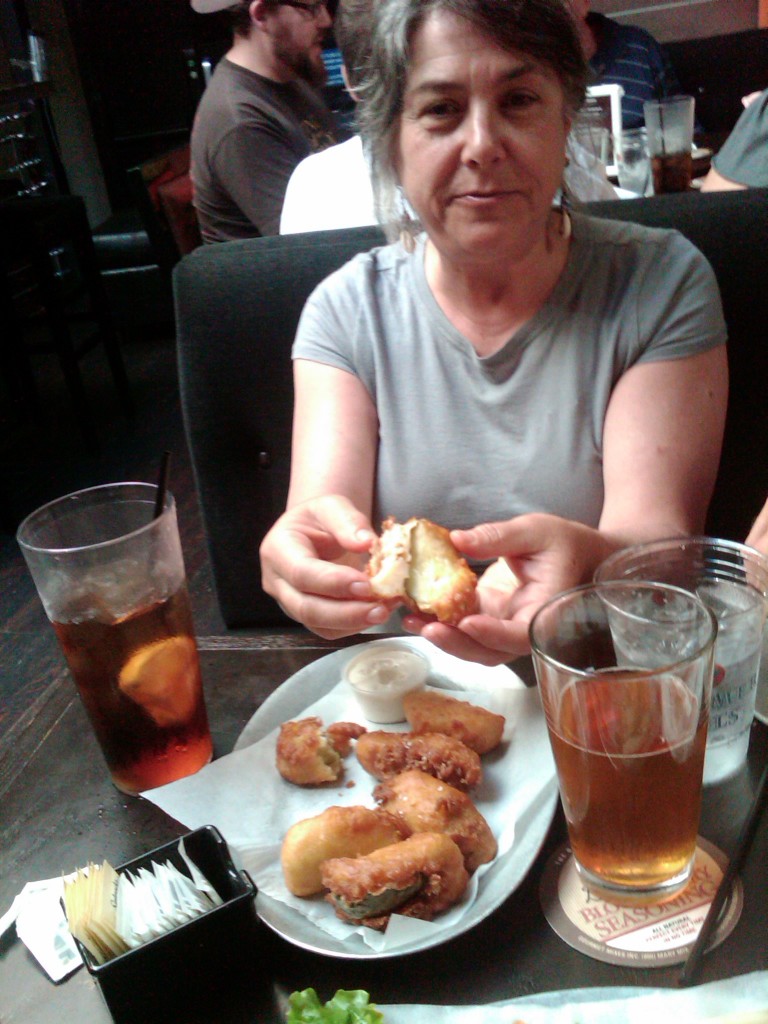
Fried pickles (Just like Pakoras)
And another American favourite:


Tater Tots! Mashed and then fried potatos (Just like Pakoras)
As you would imagine, I was very excited. Every little wish on my America to do list is being ticked off one by one. The San Diego Padre's won 4-3. Thanks to Dave and Sara it was a very informative, entertaining and fun experience. Right from the coordinated cheering, Mexican waves, the 7th innings stretch, singing the 'Take Me Out To The Ball Game' song, eating Ice-Cream Sundae's on souvenir San Diego Padre Hats, I did it all. Here are some pictures from the game:


Dave, Tannis and Sara - my partners in crime.
the Ball Park
We had great seats
Strike 1, 2, 3 - You' re Out!
Since, my only reference to Baseball was the movie Major League, I wanted to get a more realistic taste of the game. Mission accomplished.

Come. Drum. Be One.

Taal Inc.