
Saturday, 10 August 2013

Day 9 - Our last day with Mamady Keita.
The walk from the Aussie house to Kava is much shorter and so, I woke up at the usual time (7:00 am) and had time for some Suryanamaskar (Sun - Salutation) and some breakfast (Peanut butter and jelly sandwich and muesli) before I went to Kava for our last class with Mamady. I must admit that I was feeling rather sad about that. I was happy to drum of course, but there was a heavy feeling in my stomach.
I think Mamady probably expected this feeling in the air in class and so we played a rhythm called 'Kedju'. This rhythm is one of Mamady's creations and is a joke between young people (boys and girls) The word 'Kedju' means 'ugly'. It doesn't mean 'ugly' in a mean, hurtful manner but in a way of lightly and lovingly teasing somebody. One night in Balandugu, Mamady heard some children sing this song. The rhythm just came to him thereafter. The Dunun pattern in this rhythm is a very interactive one. The patterns came (and usually come) to him as a melody. Mamady broke down this melody as individual Dununba, Sangban and Kenkeni parts. The djembe accompaniments have been taken from traditional rhythms. This is a rhythm full of a very childlike, fun, free and joyous energy. The girls gather around on one side and the boys on another and sing this song to each other with their facial expressions and body/hand gestures following in animated vigour. They sing to each other, "The friendship of an ugly boy/girl; that doesn't please me!"
Like so:
 |
| Kedju - The friendship of an ugly boy, that doesn t please me! |
The words to the song are:
Kedju La Kanin (An ugly friendship)
Sunguru (ugly girl) / Kamberin (ugly boy)
Kedju La Kanin Mandinye (It doesn't please me)
Here's what this cute song sounds like: Kedju Song
The song was led by Monette who walked in around an hour or two into our class (after our initial break) and brought along with her a breath of fresh air: her daughter Nasira. Here's a cute picture of the family:
 |
| Nasira, Monette and Mamady - Picture Perfect! |
The first half of our class was not easy to get through. We performed the long break in the introduction (created by Mamady) and this took us a while to get correctly. I knew this break previously as we had played it during the Mini-Guinea workshop in Singapore for the Pyramid Performance yet, it was a much needed revision for me. I can feel the difference in how I feel while playing the djembe now in comparison to last year. I believe that I am able to play with more awareness and control. My precision with the tone and slap has also improved over the last ten days. After sorting out some hairy portions in the break, we finally got the phrase decently with Mamady playing along with us. but since 'Trust should not exclude testing', we played it many a time without Mamady and finally started playing with rhythm, feeling, technique and precision; the four components of a good Djembefola/folette.
"The djembe is an energetic and natural instrument," said Mamady as he emphasized the primal nature of the djembe. The spirit of the Djembe is similar to the spirit of Nature; inclusive, communicative, giving, unconditional and omnipresent. I remembered Mamady talking about communications taking place on various levels when one plays the djembe during the Singapore workshop as well. Firstly, he said that while playing the djembe, one makes a connection with the djembe. Therefore one doesn't need to look at the instrument while playing since the spirit of the player and the djembe are already one. Secondly, one communicates with the dunun section behind the djembe. This is the foundation, the basis on which the djembe speaks and colours rhythmically. Next, one communicates with the rest of the band/ensemble while playing the djembe. And lastly, (and most importantly) one communicates with the audience one is playing for. The djembefolas (and any performer for that matter) open their hearts while performing. They feed off of the energy of the audience and if not, in Mamady's words, "It doesn't work."
This is what the break and the rhythm 'Kedju' sounds like: Kedju Break
After our class finished Mamady spoke and really reached out to all our hearts. He said that it was the end of this workshop with him but not the end of the world. We would all take back what we have learned in these ten days and if we put it to good use and spread it in the spirit it was taught to us I believe we would be respecting both Mamady and Famoudou.
"Whenever you touch your Djembe, even if it's for two seconds, know that my heart and Famoudou's heart are with you. You are not like the white people (or foreigners - to be fair, sensitive to and inclusive of the multi-coloured turn out of this Mini Guinea workshop) who came to Africa centuries ago, because you really know our culture. You understand and are genuinely interested in it and will share it in it's truest spirit. We love you very much. Thank you for your energy because it was because of that that we could open ourselves to you." I felt my eyes well-up as I heard these words; words of a master of the highest calibre, speaking humbly from his heart to mine (to ours); words that felt like a band-aid over a wound, to ease and heal the scar of a very deep, surgical learning process. It felt like, love.
Moving slowly but with smiles on our faces, we decided to go to the beach: the only part of San Diego I was yet to see. The group was Keli (San Diego Best Host contender # 1), Kim (also San Diego Best Host contender # 1), Devra (a.k.a MJ), Tannis, Jamie (from Canada), Kun (from China) and Sue. There is a certain something about the beaches of San Diego that surpassed my impression which was hitherto, purely based out of watching 'Baywatch'. There were Pelicans and seagulls everywhere. It was nice to see the skill of surfers up front and live. We played some football, lazed around and eventually headed to Sunset Cliffs experience the legendary West-Coast Sunset. I think that it was here that I felt a positive sense of inspiration and completion. Not that this was my last day. I have one more day with Famoudou but nonetheless. Over the past two weeks, I have met people from all over the world who have been bitten by the Percussionitis bug, united by the djembe. I've been witness to hospitality, culture, new friendships and new connections all thanks to this instrument. It was one of those moments when I felt connected to the universal source of energy. Thank you Tam Tam Mandingue for making this possible.
And in continuation and scaling-up of my Cartwheel tour of Europe, I thought I'd include America in this as well. What can I say, I felt inspired...
 |
| Sunset Cliffs |
Come. Drum. Be One.
Taal Inc.
Website
YouTube
Blogger
Day 7 - Drumming on Planet: Mamady
As I walk to Kava gallery every morning, a little pattern is evolving. I walk down India street. I take a moment to stop, stare and appreciate the Jacaranda trees as I walk a few blocks ahead. I stop at the Seven Eleven and pick up some fruits and my morning coffee. I am invariably going over the previous day's rhythm in my head and letting my thoughts wander. Before I know it, I reach the venue where the early birds are ensuring that they've gotten te best seats in the class, that their recorders are in place and working correctly, practising their technique, enjoying some morning sun and so on.
Before I start describing what rhythm we played today, I'd like to share another wonderful story uncovered by fellow djembefola, music composer, producer and friend Bruno Coon who also, incidentally, is the person who has worked with A. R. Rehman and played some Cora/Kora for him on one of his projects. (Yes, I will get more information on this). The world is small is probably an overused sentence but the connections that draw us all close together never cease to amaze me. Here's a story that Pune will be very proud of: (In Bruno's words)
Bruno Coon: "So I had the phrase "Carpe Diem" in mind and remembered that it doesn't directly translate the way most people use it: 'Seize the Day' but it is closer to 'Pluck the Day' or maybe 'Harvest..' It's from a Ovid poem about the uncertainty of life.
In the poem it says "Don't listen to Babylonian soothsayers" So the Internet being what it is, I thought I'd look up "Babylonian Soothsayers". Well, Wiki doesn't have it, which means I win some kind of prize. What did turn up was a story about a religious practice among Babylonians.
They would tie a ball of yarn tight, play drums, burn incense and sing prayers. Then they would bat the ball back and forth. The length of time it took for the ball to unwind was the length of the petitioner's life. This ritual moved as a game to India where it took the name of the city that it was most popular in:
Pune.
Now of course, that has attained a new resonance.
Then a bit later the English showed up and stuck a few feathers in the ball and took the game with them, where it became a regular event at the mansion of a man named Badminton. So, now I know that Badminton/Pune was once a serious ritual to determine one's fate. And there were drums."
Then a bit later the English showed up and stuck a few feathers in the ball and took the game with them, where it became a regular event at the mansion of a man named Badminton. So, now I know that Badminton/Pune was once a serious ritual to determine one's fate. And there were drums."
Absolutely fascinating don't you think?I was blown away. Thanks Bruno for sharing this with me. It's been a pleasure drumming with you.
Mamady starts by saying, "You're still on Planet: Mamady!", so we were going to do one more of Mamady's rhythms. Today we played one called, 'Balandugu Sila.' Balandugu is the village where Mamady is from and 'Sila' means 'The Route/the way/or (sometimes) the path." The path from Conakry to Balandugu is about a thousand kilometres long. The journey starts at the South-West and ends at the North-East of Guinea. "Some parts of the road are bad and some are good," said Mamady as he told us how the scenery changes as the journey progresses from a coastal horizon to mountainous regions and then to the Savanah; the land of Mandingue.
After 26 long years of training, travelling and performing Mamady's journey home was a memorable one. This journey always took him back to his early days. There were happy moments, sad moments, funny and humorous moments on this journey home. This rhythm is an anchor for that part of his life.
Here's what the rhythm sounds like: Sila
We started with the song towards the end of the class and according to Mamady we would not have time to sing the entire song in the true way it is supposed to be sung (minus our respective accents!). Hence we only got a demonstration of the full version.
This is what that sounds like: Sila Full Song
We sang a short version of the song. The song remained just as sweet and thought provoking.
The words to the song are:
Sila Laka Eh
Sile Laka Ehhhhh
Balandugu Sila Laka
(Translated as - Open the road, open the way to Balandugu)
And this is what the short version of the song sounds like: (Make sure you hear the whole piece to experience the progression in the intensity of the song and the singers!
Mamady gave us some teasing and tantalizing phrases to play in the technique or improvisation section. It was just the stuff I needed to sink my teeth into. I noticed that everybody was pushing it and really striving hard to get their technique and chops sorted out. I also noticed that Mamady pushed us that extra bit so that we would rise up to the occasion and emerge from these ten days having successfully journeyed to the top of the mountain.
 |
| Mamady searching for technique phrases. Tara on Sangban, Hiroki on Kenkeni and Sico on Dununba |
I do hope to see this very room of international djembefola's and djembefolette's drumming under one roof, by a beach or in a small village in India.
Tomorrow we ride with Famoudou to a land of a new story, a new rhythm and a new song.
Come. Drum. Be One.
Taal Inc.
Sunday party with Monette's band, Day 6 of Drumming with Famoudou and San Diego first's!
This one is going to be a long one since all this drumming, sight seeing (as you will read in a bit) and blog writing has left me with little sleep. Apologies for those who looked for yesterday's entry and did not find one. This one has a two day report crunched into one.
Monette's band played at Humphrey's by the bay on shelter island drive. Kim Lohnas (contender number 1 for the 'best host' prize) drove Tannis, Daniel and myself to the venue. It was a beautiful drive. We passed India Street (Yes, I am staying at 500 West Hotel, located on Broadway and India street. Ha!) and Pacific Highway where we saw an old Piret's-of-the-Caribbeanesque ship called 'Star of India.' Ha. Ha.) I was surprised at the reference to India everywhere around me. The concert was a wonderful celebration. Monette brought the house down with her energy and beautifully soulful music. The TTM professors opened both sets with some traditional West-African drumming and each one did not cease to amaze and entertain everybody in the audience.
We got the best seats in the house I'd say. Mamady was hanging out with us; when he was not on stage of course grooving it on the congas. I asked him when he learned the Conga's and he said that he didn't and smiled.
 |
| Grandmaster Mamady Keita and moi - I 'm so overwhelmed I can t keep my eyes open! |
The night was full of energy, dancing, good food, wine, more dancing and a lot of positive vibes. It's performances like these that reassure me about the path that I walk. Performing, as an occupation, seems rather self-indulgent at times. As consolation, I remind myself that self-indulgence is a personal trait that can only be magnified by the profession one chooses. Everyone out on stage that day was overflowing with joy and love. Regardless of their trysts with fame, glamour and glitz, every member on stage and off was representing love, humility and that's what made the evening and the music come alive. You are as good a musician as you are a human was what I was thinking about as I left Humphrey's for the after-party at Winchell's Donut House where we had some doughnuts sandwiches and something to drink to bring us down from the energy high thanks to the music. This brings me to contender number 2 for the 'best host' prize - Keli Ross M'au. He plays steel drums with Monette's band, teaches and gigs in and around town a lot and is the most warm hospitable guys in the workshop. The competition is fierce though.
The next photo was taken after the gig since we found that if not for this workshop, none of us would have been here, together, learning, sharing, celebrating:
 |
| One World - Many Voices - One Rhythm. From left top to right - Cairns, New-Jersey, Tel Aviv, Utah, Singapore, Brussels, Rio De Janeiro, San Diego, Pune (Maharashtra) East Side, Chicago |
Monday morning - After sleeping only a few hours I, but I'm positive I could safely generalize without too much opposition that, we trudged along to Kava, body tired but excited nonetheless, to drum our hearts out since it was day 6 already; that meant only four more days to go!
Famoudou started this day with a story. He said, "When I say that we (Mamady and Famoudou) love women, it means we love life!"
He continued and gave us a brief history of his beginnings. Famoudou was born in 1940 near Sangbaralla, a village in the Hamanah region of Upper Guinea, the Malinké heartland and the birthplace of the Dunun family of rhythms. His father was a great farmer, hunter and fetish-maker. In fact, he had a special house for his 'Gree Gree'. Famoudou's father had eight wives and 45 children. Along with the 8 persons for domestic help, they were a large family. His father used to get djembe's so that the children would be occupied with some activity or the other through the day. Every evening as Famoudou's father would return home, he would see Famoudou with the djembe. Traditionally, Konate's and Keita's should not be Djembefola's. They are the Noble's of their community. Both masters have, nonetheless dedicated their lives to the djembe and spreading its awareness all across the globe. Thank their playful and adventurous spirits for that.
We then got down to work and played a rhythm called 'Soboninkun'. This rhythm is from Wassolon originally but we played the version that Famoudou had created, from Hamanah. The dance is similar in both versions but there are differences in the rhythm from both places.
Soboninkun is the name of a mask representing a small animal's head. It is a very special dance that requires much skill, a good sense of balance, initiation and excellent physical condition. The dance is usually performed after the big harvest.
This is what it sounds like: Soboninkun
The words of the song are:
Keren Kono Nen Kasi Kan Diye
Ehhhhh
Keren Kono Nen Kasi Kan Diye
De Wolo Baiye Tono Rombaiye
(Translated as: It is easy to bring a baby into this world but who will look after that child if not a mother?)
Keren Kono - Small bird.
This is what the song sounds like: Soboninkun Song
As you would have heard in the previous audio clip, we played a lot of phrases that we could use for various parts of a solo or improvisation section. The beginning solo phrase is called 'Doma Tama'. After Doma Tama one is free to play, express and improvise interacting with the dununs and the dancers. Thereafter there is a section called 'Kumben(g)' where the djembefola meets the Sangban in rhythm. This is to say the djembe interacts with, compliments and locks in with the Sangban before he calls the rhythm to an end or passes his solo on.
This is Famoudou during the Dunun class. A true Soboninkun dancer:
 |
| Famoudou during Soboninkun - what a beautiful heart!:) |
After class Sue (from Canada), Helen (from San Diego) and me, we went to The Burger Lounge in Little Italy on India Street, (yes, surprising right?). I had my first burger in San Diego! With every passing day I get know more about each participant in the workshop; their stories, their journey with the djembe, their philosophy and their spirit. All in all there was good company, good conversation and good food that afternoon.
See, what I mean:
 |
| The Burger Lounge - Lip Smackingly Yummy |
After a quick change and freshening up I was ready and waiting for David Visiko and Sarah Heimlich to come pick Tannis and me up to go to Petco Park to watch my first live American Baseball Game: the San Diego Padre's v/s the Kansas City Royals! En route, we had to indulge ourselves some more with the all-American-pre-game-food. And the gastronomic adventure continues:
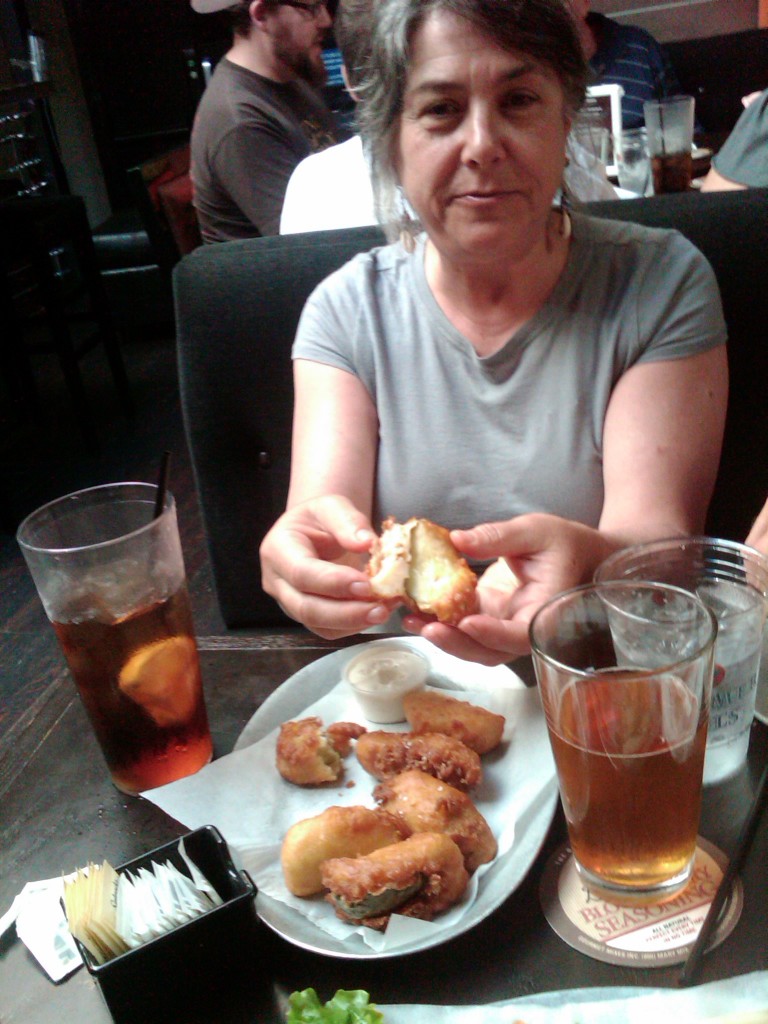 |
| Fried pickles (Just like Pakoras) |
 |
| Tater Tots! Mashed and then fried potatos (Just like Pakoras) |
 |
| Dave, Tannis and Sara - my partners in crime. |
 |
| the Ball Park |
 |
| We had great seats |
 |
| Strike 1, 2, 3 - You' re Out! |
Since, my only reference to Baseball was the movie Major League, I wanted to get a more realistic taste of the game. Mission accomplished.
Come. Drum. Be One.
Taal Inc.
Day 8 - with Famoudou Konate
This morning I walked to Kava with all my baggage so that I could move into the Aussie House after class. This is my final move until I leave for the airport on the 4th of July. Phew! It was a long walk but bumping into Sue who was also walking towards Kava made it whiz by, just like the morning breeze.
The rhythm we played today is called 'Baga Guine'; which from the 'Baga' people of the Coastal Guinea region. This is not a Malinke rhythm. The rhythm is similar to 'Makroo/Makru', a famous rhythm and dance of seduction of the 'Susu' peoople, but is a slowed down version of the same.
When the French first came to what we now call Guinea they heard the word 'Guine' being used a lot. And understandably they thought that this place would/could and should be called 'Guinea.' And so they too started refering to the place as 'Guinea.'
'Guine' means 'Women' in the language of the Baga people. In Malinke the word for 'women' is 'Muso'. And keeping with what seems like the theme of the workshop, and the insidious, deep-seeded love of 'women', it does not surprise me that the word 'Guine' stood out a lot to a foreigners ear in West-Africa. Now, people in Africa love (apart from women) their dance and their drums. Everybody is constantly ready to put their dancing shoes on. So 'Baga Guine' is a rhythm that talks about this phenomenon of a dance epidemic, so to say.
This rhythm has a very catchy song that is sung along with it. The lyrics to the song are:
(Aboroma Maboroma Ehhhh) * 3 {Are we dancing or are we not dancing?}
Eh Laila Baga Guine {The Baga women}
Fare Boroma Oto Kuide {Lets dance to the music in the car}
Magbanas or minivans are used very avidly for the transport of goods or people all over West Africa. So the people in these Magbanas just need any old excuse to get into song and dance. This rhythm gives them that.
'Boro' - Dance
'Fare Boro' - Dance to the music
'Oto' - Car
Here's what the song sounds like: Baga Guine
The dunun section of the rhythm has a distinct melody within it. Throughout today's class I paid conscious attention to this and listening aware-fully, as I played my part, made all the difference. I can best describe this opening-up of the rhythm as a 'Musician's Out Of Body Experience'. My attention passed in and out of every note that was played and I had a deep musical and emotional understanding of the rhythm. This felt familiar yet new.
This is what the rhythm sounds like. You will also hear Famoudou improvise on this one: Baga Guine Solo
Today Famoudou surprised us all by asking some of us to solo. This is the magic that is Famoudou Konate. In Monette's words, "You go wherever he takes you." Today he inspired us to speak through our djembes and say what we had to say. I must say that personally I did not seem to be able to articulate myself as well as I thought I could but many lessons were learned. All of them had to do with being fully present and aware while playing. Of course, technique, power, speed, phrases are important; but what Famoudou emphasized on most is the feeling. "For me, the Djembe is an instrument to have fun with," he said as he gave us subtle pointers on what to do and what not do while soloing. This exercise left us all with a taste of the forbidden fruit. Now, we all want to push it more.
The Dunun half of class was fun, interactive and a test of our attention skills. Famoudou gave the Dununba section varying patterns to play which would leave us with two things to do - to play our pattern on the Sangban and Kenkeni and to listen to the Dununba pattern and feel how it weaved in and out at different points with reference to the pattern we were playing. Before we knew it, we reached the end of our class. Since our curiosity and hunger for information is growing by the day, Monette announced that on Saturday we would have a Q'n'A session with both the masters and then let that organically evolve into our farewell party. "If I could open my heart and give it to you, I would," said Famoudou with reference to giving us all the information we wanted.I would like to sit down, cross-legged, under a tree, in Balandugu or Hamanah and listen to these masters talk.
Keli (now contender number 1 for the 'Best Host' prize), Sue and me had lunch ar Felipi's in Little Italy. I realized what Keli meant when he said, "You get a tonne of food for $10," as we ate a delicious sausage, mushroom and olive Pizza and a Shrimp Filipi's special pasta and got to know more about each others lives and journeys, how they have brought us here today and where they will take us tomorrow.
I moved into my new room in the Aussie house. I am staying with Michi Henning, Bruce, Linda, Rafe and Bruce. The room is beautiful and opens out into a lush green garden. Community living is something I appreciate after being alone for the last few days. Staying loyal to my day of Italian food we ate a delectable Pizza (Quatro Fromaggi) for dinner. Tomorrow we shall venture into Mexico, gastronomically speaking.
Tomorrow is also our last class with Mamady. It still doesn't sink in. It feels like I got here from India just about a day ago.
Here's to a few things: Being fully aware and present in every moment we live in, to journeys (at whatever stage we might find ourselves in), to rhythm and to life!
Come. Drum. Be One.
Taal Inc.
Day 2 - Intermediate Level with Famoudou Konate 21-06-11
This morning was slightly colder than usual and also more overcast. I am getting more and more familiar with the city. I haven't seen enough of it obviously... but all in good time. This time I did not loose my way. I reached well in time and thought I'd shift places so that I got a different perspective to class. I took my notebook and pen out, had my djembe in front of me and I was ready for class with Famoudou Konate (or so I thought...)
You know how an event is truly international? Of course when there are participants from all over the world. Agreed. As we waited for Famoudou to enter, I got talking to the person sitting next to me and found out that she has not only visited India but, been to Pune. She had performed in Pancard clubs, Baner Road, for New Years 2004, as a Michael Jackson impersonater. Next, sometime during the day I met an individual who played a bit of cora (traditional West-African harp like instrument) and worked with the great A.R Rahman. These two things just fuelled my truly international yet homely experience.
Within minutes Famoudou's djembe took its rightful place in class which meant the the master was not far. He has a simple, beautiful djembe with a beautiful message. This is what it looks like.
 |
| The master's djembe |
 |
| Famoudou Konate's message to the world |
What is very typical of Famoudou is his organic, very haphazard yet very comprehensive and detailed method of teaching. By now since I have been exposed to none other than Mamady who is a very structured teacher, Famoudou's technique was new, was like a journey, non-stop and literally like a work-out. We did not know how four hours whizzed by but for this amazing buzz in our hands and hearts at the end of the session.
Famoudou explained that in the then polygamous society how there would be arrogance in the youngest (newest) wife of a man and jealousy amongst the other wives; how there would be arrogance in a man who is tall, well-built and strong and how this song and this rhythm is played to say, 'don't be arrogant.' The words of the song are:
Moso Kenya Kenya (Beautiful Woman)
Kani Yereke (Don't be Arrogant)
Yo Ala Midan
Den Mosoni Kenya Kenya
Kani Yereke Yo Ala Midan
This is what the song sounds like: Arogan
Now, I have not seen such a vibrant, colourful and animated teacher in a long long time... Famoudou takes you on a journey with his sessions. To start off, we played some call and response exercises to test out respective levels. Little did we know that each of the phrases that he was playing culminated into what was the solo phrases that was traditionally played for this rhythm. As we grasped the first djembe accompaniment Famoudou switched into the song where he invited some women to dance in a circle. The dance did resemble our dandiya/garba dances quite a bit but for the peculiar and typical shoulder and hip movements that's commonly associated with West-African Dance. Throughout the class Famoudou was like a butterfly; walking, dancing, playing djembe and one thing is constant - his smile. There is something about this master's aura. He played complex roll's with composed poise, explained history of the rhythms with utmost detail and demonstrated the 'arrogant woman walk' with the grace of a dancer. Don't believe me...? Come, have a look see...
 |
| The multifaceted master, this time in his dancing avatar - 'The arrogant woman' |
If you're wondering how he's being so convincing...he's using plastic water bottles for some help in the, ahem, pectoral area!
After two hours, we took a small break all we were left with was a wide grin from ear to ear and hands that were feeling alive and charged. A well deserved snack and drink break followed after.
I have probably done this in my last two entries but I want to take a moment to mention the warmth and openness of the Tam Tam Mandingue family. Apart from Mamady and Famoudou the entire staff and all the TTM certified teachers have been and continue to be amazing sources of information and help to any participant. You all know Tara Tucker from Drum Up Big from my previous votes of thanks (It's her birthday today - so Happy Birthday to the meanest Tasmanian Djembefollette-devil there is). To add to this Hiroki Murai from Folikan, director of TTM Fukuoka, Japan - djembefola extraordinaire and a thorough gentleman. Michael Taylor from Holygoat Percussion, director of TTM Chicago; he has released a very valuable DVD for all aspiring djembefola's out there. Check out his link for more. It is these people, amongst others like Jeremy (TTM Belgium), Pierre Chaillan (TTM Isreal) who will be taking the mission of West-Africa forward. I appreciate their warmth, support, love and un-conditionality greatly. Thanks guys!
Next, we were playing dununs. The whirlwind of drumming started once again. As we went through the dunun parts, the professors were laying down some wicked djembe solo's that would keep distracting me... in a very inspiring way of course; I was completely enjoying my dunun experience. Soon, Famoudou was out in the other hall dancing like a beautiful ballerina. He seemed to be in his own world and before we knew it, most of us were in it. A bunch of the participants, were bit by the dancing bug and they were following Famoudou's every move. This was trippy. At the end of the four hours, we had gone through djembe accompaniments, history, solo sections, dunun sections and even dance steps of 'Arogan.'
With the same energy, gusto and youthful smile that he entered with, Famoudou said, "à demain," and his session was called to a close.
Since I wanted to take in all I could from the workshop I sat through the advance class as well; of course due to lack of space, we were allowed to wait by the side-walk; but it was worth every minute. Mamady started with a song as well and a very beautiful one at that. I will put up the song with it's words and meanings soon. To me, this rhythm has an addictive dunun pattern. The Dununba was the backbone keeping everybody in time while the Sangban and Kenkeni conversed with each other through the rhythm. Here's audio proof of why I said it was worth it:
Tomorrow we continue with Mamady Keita.
What a ride this is going to be...
Come. Drum. Be One.
Taal Inc.
Day - 3 with Mamady Keita (New Rhythms)
Today's excellence is tomorrow's tradition; a beautiful thought I've been chewing on all day.
Today we learned some new rhythms created by Mamady. He announced during the inauguration gathering that this time, apart from traditional rhythms, he would focus on his own rhythms as well. This was all a part of telling new stories that will turn into epics and soon after, tradition. There are many popular traditional rhythms like Kuku and Mendiani; whose origins are unknown today because the story, the philosophy wasn't transmitted or got lost along the way. Today thanks to our handy-dandy Dictaphone and recording devices a legend shall live on... mainly in our beings.
The first rhythm we learned was called, 'SIRA.' This is a rhythm created by Mamady Keita in 2007 dedicated to his mother, 'Nasira.' With a bout of inspiration, he woke up the day before yesterday early in the morning with the words and tune to this song and since he didn't want to disturb his wife and daughter he recorded the tune on his phone in the toilet. We are all lucky to witness this; history in the making I think..
Mamady's moother was a great woman. She went to a fortune-teller when she was pregnant with Mamady and she was told that 'he will make a name by amusing himself.' And so it was... Mamady, at a very young age started playing on pots and pans. Mamady got his first djembe at a very young age; the instrument was taller then him many would say. After a very sacred offering of cola nuts to his to-be teacher, we have what we see before us today - a true master. Mamady's Master's full name is Karinka Djan Conde. First name is Karinka and family name is Conde.The middle name 'Djan' means 'Big' because he was a big man. He was not a famous musician. Mamady describes him as 'a simple farmer in our village. But a true Master'.
Mamady is the last (7th) child of his family. Nasira, his mother, gave him everything he ever needed. She would say, "Take the best of me and father and leave the bad part." It was because of his mother that Mamady was bestowed with true values, with respect, with education; all pillars to help build his philosophy. "I will follow her advise forever since my present is her gift," he said.
For the first time online, (I believe) the words for 'SIRA', by Mamady Keita:
Ee Sira Demoila (You, who has children)
Na Sira Demoila Gnuma (My Sira {short for Nasira} You are a good mother)
This is what the song sounds like with the Dununs and Mamady playing the djembe when he is not singing:
Sira
Sira
The song is played much faster during performances. The group was at a stage where this speed seemed right. This song has a haunting nature to it. It is one of those songs that reminded me of many a 'Bhajan' sung during 'Satsangs or Kirtans' back home. It's a repetitive tune that is easy to sing and has an instant appeal to one and all. I suspect we will be singing this sometime soon during djembe class in Pune soon!
And as promised, the sweet song that the advance level sang and played yesterday is called 'YELENA'. This is also a rhythm that Mamady created. The rhythm, you heard yesterday. The song that goes with it is the sweetest song I have heard in a while. It's a naughty yet cute way of asking for forgiveness. I think it's something us guys could use to set things right with our loved ones. (And for those with things all fine and dandy with their ladies, keep this in your repertoire... I'm sure it'll be of use one day!) The words to the song are:
Yelena N'Doni (Smile at me my dear)
Yelena N'Sonte (It's not my fault)
And this is what it sounds like: Yelena
The recording of the group singing the song yesterday was bad and so I couldn't upload it; But it sounded like a beautiful church song. This one is just a substitute to give you a better idea of the song. Women, don't you just feel more forgiving now?
Coming back to today's class... the next rhythm we started but didn't finish due to lack of time is called, 'BARA'. There is a short emphasis of both the syllables in the word. If one emphasized on the first syllable only the word would mean 'work' and if one focused only on the second, it'd mean a certain type of gourd. Malinke is such a language where emphasis and accent is very important.
'Bara' is the place where the village festivals are held. When Mamady was very young, he was taken away from his village Balandugu to brought to Siguiri. Mamady cried all the way up to his destination. He was sad and lost since he was separated from his family, his friends, his village, separated from the 'Dubalen' (a tree that saw him grow up.) In Siguiri some people called him to the bara and that was where his journey with the djembe continued and grew without limits. Mamady returned to Balandugu only after 26 years. That was how long he was on his own. He hence, made this rhythm in memory of the bara in Siguiri as he will never forget the day he arrived there, young, lost and weary. This song is an anchor reminding each and every one of us about courage and excellence; two values this master embodies.
 |
| Mamady Keita in his element |
This is what Bara sounds like: Bara
Tomorrow is class with Famoudou again. I wonder what dance, song, rhythm we are going to get into... I wonder where I'm going to be taken and then I say, as long as my foundation is strong, wherever I fly, I do with courage and excellence...
Wassa Wassa everybody.
Come. Drum. Be One.
Taal Inc.
Subscribe to:
Posts (Atom)